
Solution
CQC compliance software for supported living
Supported living is judged on whether people have real choice and control in their own homes. The evidence looks different from a care home, and the audit programme in MyCareCompliance reflects that — tenancy and capacity records, positive risk taking, outcomes in people's own words, and the governance to prove it.
MyCareCompliance brings practical CQC audits, evidence, workforce oversight and improvement actions into one platform for adult social care providers.
7 days free, card required, £0 today. From day 8 your plan (from £24.99 a month, inclusive of VAT) is charged automatically unless you cancel before your trial ends. Features vary by plan. Compare plans and trial terms.
The problem
Support spread across many small addresses
Staff work across several shared houses and individual tenancies. Managers can't easily see which addresses have out-of-date support plans or restrictive-practice reviews, or which staff are missing training for the people they support.
How MyCareCompliance handles it
Fictional walkthrough — no real provider, person or result
- 1
Found. A fictional provider's Care Plan Audit across four addresses finds two plans past their review date.
- 2
Owned. Two actions are raised, one per address, each with its own owner and due date.
- 3
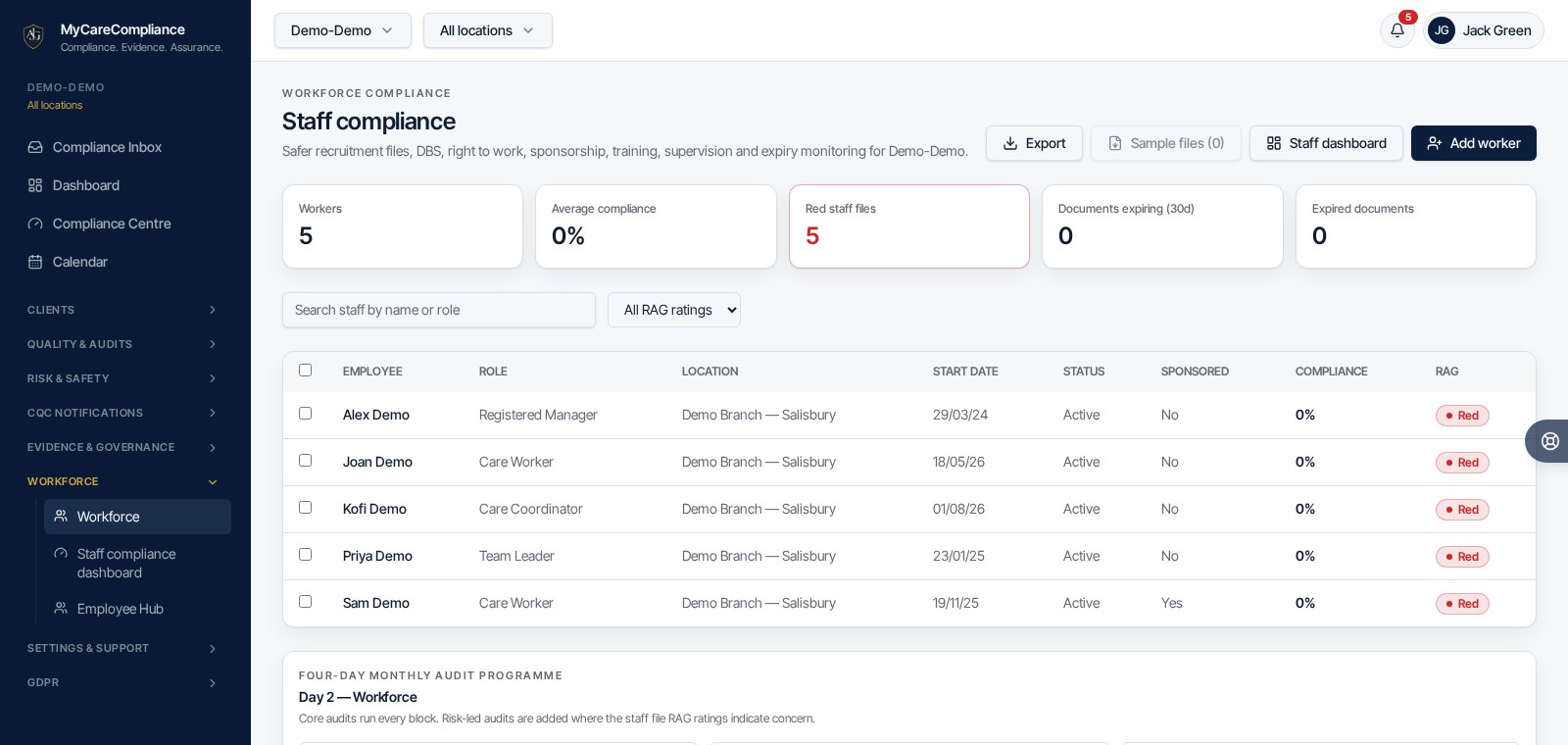
Workforce checked. Workforce compliance shows one staff member's positive behaviour support training has expired; a renewal is requested via the Employee Hub.
- 4
Fixed. Updated plans, involving the person and their advocate, are added as completion evidence.
- 5
Verified. The registered manager verifies both actions; the organisation view shows every address up to date.
Included features
- Care plan, MCA / consent and medication audits
- One licence for every address and scheme
- Workforce compliance and Employee Hub requests
- Improvement actions with named verification
- Organisation and single-location governance reports
What compliance looks like in supported living
The service is in someone else's home, and the person is a tenant first and a person receiving support second. Inspectors test whether support enables independence or quietly institutionalises it: are there blanket rules, is risk used as a reason to say no, does the person decide how their money and their day are used? A supported living provider therefore needs audit evidence about rights and outcomes, not just task completion — plus the usual workforce and medication assurance.
Choice, control and outcomes
Audits look for evidence that people make real decisions about their own lives, with outcomes recorded in their own words wherever possible.
- Support plans written with the person, not about them
- Choice over daily routine, activities, food and household decisions
- Control of money, benefits and personal finances
- Community access, work, education and relationships
- Outcome reviews that show progress, not just activity
Tenancy, capacity and consent
The legal framework around someone's home is a distinct evidence area in supported living and a common gap at inspection.
- Tenancy agreements and the separation of housing from support
- Mental capacity assessments and best-interest decisions
- Deputyship, appointeeship and advocacy involvement
- Court of Protection authorisations where relevant
- Consent records with review dates tracked
Positive risk taking
Risk assessments are checked for enabling language and proportionate restriction rather than blanket rules — a recurring theme in inspection findings.
- Risk assessments that enable rather than prohibit
- Restrictions identified, justified, reviewed and reduced
- Blanket rules challenged and recorded
- Lone working and out-of-hours support arrangements
- Incident learning fed back into the support plan
Medication and health
Support ranges from full administration to a person managing their own medicines, and the evidence must match what actually happens.
- Self-administration, prompting, assisting and administering recorded correctly
- MAR chart audits and PRN protocols
- Medication competency per staff member with renewal dates
- Health action plans, annual health checks and hospital passports
- Errors and near misses logged, investigated and closed
Workforce compliance and consistency
Consistent, well-matched staff are one of the strongest indicators of a good supported living service.
- DBS, right to work, references and recruitment file completeness
- Training specific to the people supported
- Supervision, appraisal and observed practice
- Staff matching, consistency and turnover as culture indicators
- Expiry alerts so nobody works on a lapsed record
Governance and Regulation 17
Regulation 17 expects systems that assess, monitor and improve quality, and records that evidence it, across every setting you operate.
- A scheduled audit programme per setting
- Improvement plans with owners, priorities and due dates
- Overdue and urgent items surfaced before they become findings
- Branded governance reports for provider meetings
- A full history of who recorded what, and when
Frequently asked questions
- Is the audit content different from a care home?
- Yes. Supported living is judged on whether people have genuine choice and control in their own homes, so the audits focus on independence, tenancy rights, proportionate risk taking and outcomes in the person's own words, rather than on a regulated building.
- Can we run separate records for each supported living setting?
- Yes. Each setting or scheme has its own audit programme, evidence library and improvement plan, and senior managers see every setting together in one Compliance Centre view.
- Does it cover Right Support, Right Care, Right Culture?
- The audit content reflects those expectations: individualised support, rights-based practice, reducing restriction and a culture that enables people. Learning disability and autism services can also use the dedicated audit set for those settings.
- How does it handle medication when people self-administer?
- Audits distinguish between self-administration, prompting, assisting and administering, check the supporting risk assessment and capacity decision, and track staff medication competency with renewal dates.
See it with your own service
Book a free demonstration and we will walk through the platform using scenarios from a service like yours.
7 days free, then from £24.99 per month, inclusive of VAT. Features vary by plan; compare pricing and trial terms before choosing.